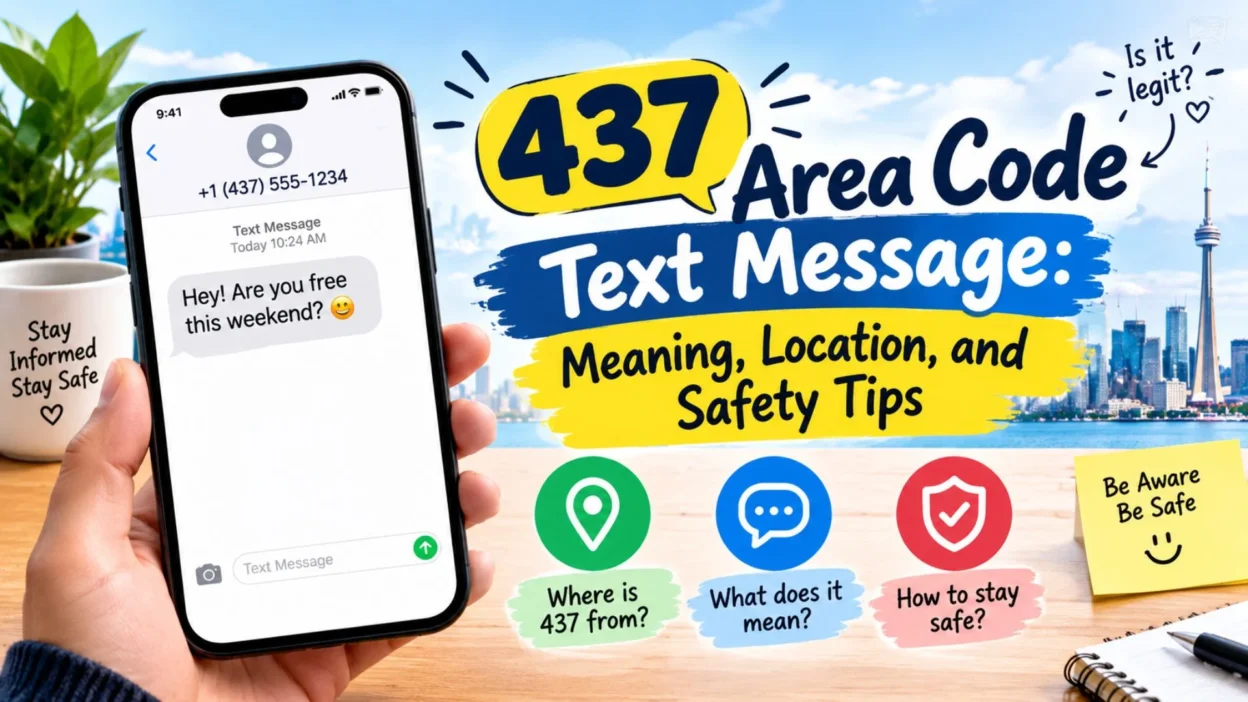
Have you received a text message from a phone number starting with 437? You may wonder where the number comes from, who sent the message, and whether it is safe to reply. Understanding the 437 area code can help you make sense of unfamiliar texts and avoid common phone scams.
The 437 area code belongs to Toronto, Ontario, Canada. It serves the same general geographic area as the 416 and 647 area codes. Therefore, a message from a 437 number may come from a person, business, or service connected to Toronto.
However, the area code alone cannot confirm who sent a message. Some texts are completely legitimate, while others may be unwanted or deceptive. Scammers can also disguise caller ID information to make a number appear more trustworthy.
This guide explains what a 437 area code text message means, why you might receive one, how to recognize suspicious messages, and what steps you can take to protect your personal information.
What Does a 437 Text Message Mean?
A 437 text message is an SMS sent from a phone number that uses Toronto’s 437 area code. It may be a personal message, a business notification, an appointment reminder, or an unexpected contact.
The number itself does not reveal the sender’s identity. Instead, it provides a geographic clue about the telephone number.
Here are some common reasons you might receive a message from this area code:
- A friend or family member may have a Toronto phone number.
- A business could send an appointment confirmation.
- A delivery service might provide an order update.
- Someone may contact you about a meeting or reservation.
- A company could send a customer service notification.
- An unknown person might have entered the wrong number.
- A marketing service may send a promotional message.
- A scammer could attempt to start a conversation.
The message’s content matters more than the area code alone. If you recognize the sender and expected the communication, it may be routine. However, unexpected links, payment requests, and demands for private information deserve extra caution.
Where Is Area Code 437 Located?
Area code 437 is associated with Toronto, Ontario, Canada. Toronto is a major Canadian city known for its diverse communities, businesses, universities, and cultural attractions.
The 437 area code operates as an overlay alongside area codes 416 and 647. This means multiple area codes serve the same general geographic region.
A phone number beginning with 437 may belong to a resident, organization, or business connected to Toronto. Nevertheless, the number does not prove that the sender is physically present there.
For example, someone may keep a Toronto number after moving elsewhere. Internet-based calling services may also use numbers associated with a particular region.
Keep these points in mind:
- Country: Canada
- Province: Ontario
- Main city: Toronto
- Related area codes: 416 and 647
- Possible use: Personal calls, business communications, and text messages
Consequently, a 437 prefix provides useful location information, but it cannot identify a specific person or establish their current whereabouts.
Why Did a 437 Number Send You a Message?
Receiving an unfamiliar text can feel confusing, especially when the sender provides little context. Fortunately, several ordinary explanations may account for the message.
A legitimate sender might be contacting you for a practical reason. Alternatively, the number may have reached you by mistake.
Consider these possibilities before deciding what to do:
- Personal contact: Someone you know may have a Toronto-based number.
- Business update: A company might confirm a booking or appointment.
- Delivery notification: A courier may provide information about a parcel.
- Wrong recipient: The sender could have mistyped a digit.
- Customer service: A business may respond to an earlier inquiry.
- Marketing message: A company might share an offer or announcement.
- Automated alert: A service may send a routine account notification.
- Unwanted contact: A stranger might send an unsolicited message.
- Possible scam: Someone may try to obtain personal information or money.
Do not assume that every unfamiliar number is dangerous. At the same time, avoid trusting a message simply because it looks professional.
If the text claims to represent a company, verify it independently through the company’s official website or established contact details.
Are Messages From 437 Numbers Legitimate?
Messages from 437 numbers can be legitimate, but the prefix cannot establish whether a particular text is trustworthy. Both genuine senders and dishonest individuals may use numbers with this area code.
A normal message often explains its purpose clearly. For instance, it might confirm an appointment you recently booked or provide an update you expected.
Suspicious messages may use a different approach. They might promise an unexpected reward, claim your account will close, or demand immediate payment.
Look for these warning signs:
- The message arrives unexpectedly and provides no clear explanation.
- The sender asks for passwords or security codes.
- A link leads to an unfamiliar website.
- The text threatens account suspension unless you act immediately.
- The sender requests payment through an unusual method.
- An unexpected prize requires a fee before collection.
- The message contains strange details or inconsistent branding.
- The sender pressures you to keep the conversation secret.
- A supposed company refuses to let you verify the request independently.
One warning sign does not always prove fraud. However, several suspicious details should encourage you to stop and verify the message before taking action.
Common Scams Involving Unexpected Texts
Text message scams, sometimes called smishing, attempt to trick recipients into revealing private information or taking an unsafe action. Scammers may pretend to represent banks, delivery companies, government agencies, or familiar businesses.
A message may look convincing even when its claims are false. Therefore, examine the request instead of relying on the sender’s displayed number.
Common examples include:
- Delivery problems: A text claims your parcel cannot be delivered until you pay a fee.
- Bank alerts: Someone claims your account has a problem and asks you to sign in through a link.
- Prize offers: A message promises a reward you never entered to win.
- Account warnings: The sender threatens to suspend a service unless you act quickly.
- Refund claims: A supposed organization offers money and requests banking details.
- Fake job offers: A stranger promises easy earnings but asks for personal information.
- Unexpected payments: Someone claims you owe money and demands immediate payment.
- Verification requests: The sender asks you to share a one-time security code.
- Wrong-number conversations: A stranger starts a friendly chat and later introduces suspicious offers.
These examples describe general text scams, not verified incidents involving every 437 number. The area code itself does not establish that a sender is involved in fraudulent activity.
For additional guidance, Canada’s Get Cyber Safe website explains how to recognize and avoid smishing attacks.
How to Check an Unknown Sender Safely
If a 437 number contacts you unexpectedly, take a moment to review the message before responding. A few simple checks can help you avoid unnecessary risks.
Start by checking the context. Did you recently contact a Toronto business, arrange an appointment, or expect an update? If so, the message may relate to that activity.
Next, examine what the sender wants. A straightforward notification is different from a message demanding money or confidential details.
Use these practical checks:
- Review the message for a clear explanation.
- Think about whether you expected the communication.
- Check whether the sender identifies a recognizable organization.
- Avoid opening unexpected links or attachments.
- Search for the organization’s official contact information independently.
- Contact the company through a trusted channel if necessary.
- Compare the request with information in your own account.
- Ignore pressure to act before you can verify the details.
- Block the sender if the contact becomes unwanted or threatening.
Remember that searching for a number online may produce incomplete or misleading results. A number’s reputation can change, and reports from strangers may not tell the full story.
The safest approach is to verify the actual request rather than relying on a single online report.
What Should You Do After Receiving a Suspicious Text?
You do not need to answer every unfamiliar message. If a text looks suspicious, leaving it unanswered is often the simplest choice.
Avoid clicking its links, downloading attachments, or providing private details. You should also avoid calling a contact number supplied in a questionable message.
Instead, follow these steps:
- Stop before following any instructions.
- Do not share passwords, banking information, or verification codes.
- Avoid paying unexpected fees.
- Verify any claimed account problem through the official service.
- Block the sender if the message is clearly unwanted.
- Use your phone’s spam-reporting feature when available.
- Save relevant evidence if you need to report a serious incident.
- Ask a trusted adult for help if you are unsure what to do.
In Canada, suspicious text messages can generally be forwarded to 7726 (SPAM), depending on your mobile provider. You can also report suspected fraud to the Canadian Anti-Fraud Centre.
These precautions apply to suspicious texts from any area code, not only 437.
Can You Identify the Person Behind a 437 Number?
An area code cannot tell you exactly who owns a phone number. It identifies a numbering region, not a person’s name, identity, or current location.
Some legitimate businesses publish their contact numbers online. However, personal mobile numbers may not appear in public directories, and online lookup services may contain outdated information.
There is another important limitation: scammers can spoof caller ID information. This means the number displayed on your phone may not accurately identify the person or organization responsible for the message.
For that reason, be cautious about websites that promise to reveal a person’s private details. Avoid sharing your own information with an unfamiliar lookup service.
If a message claims to come from a known business, contact that business through its official website or a previously verified phone number. This method provides a more reliable way to check the claim.
If the message involves threats, repeated harassment, or suspected fraud, keep relevant records and seek help from an appropriate reporting service.
Why Do Some 437 Texts Look Like Local Messages?
A local-looking number can make an unfamiliar message seem more familiar. For example, someone who recognizes Toronto’s area codes may assume that a 437 text comes from a nearby business or resident.
However, the displayed prefix is not proof of physical location. People can keep their numbers when moving, and some services support calls or texts through internet-based systems.
Scammers may also use spoofing techniques to make messages appear connected to familiar numbers or organizations.
Keep the following distinctions in mind:
- A Toronto area code does not prove the sender is currently in Toronto.
- A familiar prefix does not guarantee that the message is genuine.
- A professional-looking text does not establish the sender’s identity.
- A suspicious message can use a number that appears local.
- A legitimate organization should allow you to verify important requests independently.
Therefore, focus on the message’s purpose and requested action rather than assuming that a local-looking number is automatically safe.
How to Protect Your Phone From Text Scams
Good digital habits can reduce the risks associated with unwanted messages. You do not need advanced technical skills to protect your information.
Start by keeping your phone’s operating system and messaging applications updated. Security updates can help address known weaknesses and improve protection features.
You can also take these steps:
- Enable available spam filtering on your device.
- Use strong, unique passwords for important accounts.
- Turn on multifactor authentication where available.
- Never share one-time verification codes with another person.
- Avoid posting your phone number publicly when unnecessary.
- Review account notifications through official applications.
- Check website addresses carefully before entering information.
- Block repeated unwanted contacts.
- Report suspicious messages through appropriate channels.
- Learn how legitimate services normally contact you.
Whenever possible, use an authenticator application or another secure authentication method instead of relying only on text-message codes.
Most importantly, remember that a message demanding immediate action deserves careful review. Legitimate requests should be verifiable without exposing your private information to an unknown sender.
What If You Already Replied to a 437 Text?
Replying to a message does not automatically mean that your information has been compromised. The next steps depend on what you shared and whether you followed any links.
If you only sent a brief reply, stop communicating if the conversation begins to feel suspicious. Avoid sharing further details, and block the number if needed.
If you clicked a link, do not enter additional information. Close the page and review whether you downloaded anything or granted unusual permissions.
If you shared a password, change it through the official website or application. If you provided banking details, contact your financial institution using a verified number.
If you disclosed a verification code, review the relevant account’s security settings and sign out of unfamiliar sessions where possible.
You should also consider these actions:
- Change any exposed passwords that you still use elsewhere.
- Enable multifactor authentication on important accounts.
- Review recent account activity for unfamiliar changes.
- Contact your mobile provider if your phone service suddenly stops working.
- Tell a trusted adult if you need help assessing the situation.
- Report suspected financial fraud to the appropriate authorities.
Act promptly if you shared sensitive information. Quick action may help reduce further problems, although the exact response depends on the information involved.
Frequently Asked Questions About 437 Area Code Text Messages
Is 437 a Canadian area code?
Yes. Area code 437 serves Toronto, Ontario, Canada, as an overlay with area codes 416 and 647.
Why am I getting texts from a 437 number?
The sender could be a person, a business, an automated service, or someone who entered the wrong number. Unwanted marketing and scam attempts are also possible. The message itself provides more useful clues than the prefix alone.
Is area code 437 associated with Toronto?
Yes. It is associated with Toronto, Ontario. However, the displayed area code does not prove where the sender is physically located when sending a text.
Are all 437 text messages scams?
No. Many numbers with this area code may be used for ordinary communication. Evaluate each message individually, and be cautious if the sender requests money, private information, or urgent action.
Should I reply to an unknown 437 number?
If you do not recognize the sender, you generally do not need to reply. Avoid responding to suspicious messages, especially those containing unexpected links or requests for sensitive information.
Can a scammer fake a 437 phone number?
Yes. Caller ID spoofing can make a call or message appear to come from a different number. Consequently, the displayed area code alone cannot verify the sender’s identity.
How can I report a suspicious message in Canada?
You can use your phone’s spam-reporting feature and, where supported, forward suspicious texts to 7726 (SPAM). Suspected fraud can also be reported to the Canadian Anti-Fraud Centre.
Conclusion: Stay Informed About 437 Text Messages
A 437 area code text message usually indicates a number associated with Toronto, Ontario, Canada. It may come from a friend, a business, or an automated service. However, the prefix alone cannot establish who sent the message or whether its contents are trustworthy.
If you receive an unexpected text, review its purpose before taking action. Avoid suspicious links, protect your passwords, and never share verification codes with an unknown sender. When a message claims to represent a company, verify it through an official contact channel.
Most importantly, stay calm and use common sense. You do not need to panic whenever an unfamiliar number appears on your screen. A careful check can help you distinguish routine communication from a potential scam and protect your personal information.

Emma Richardson is a content writer passionate about creating heartfelt messages, wishes, and greetings for every occasion. She enjoys helping readers express their emotions with meaningful words that strengthen relationships and celebrate life’s special moments.