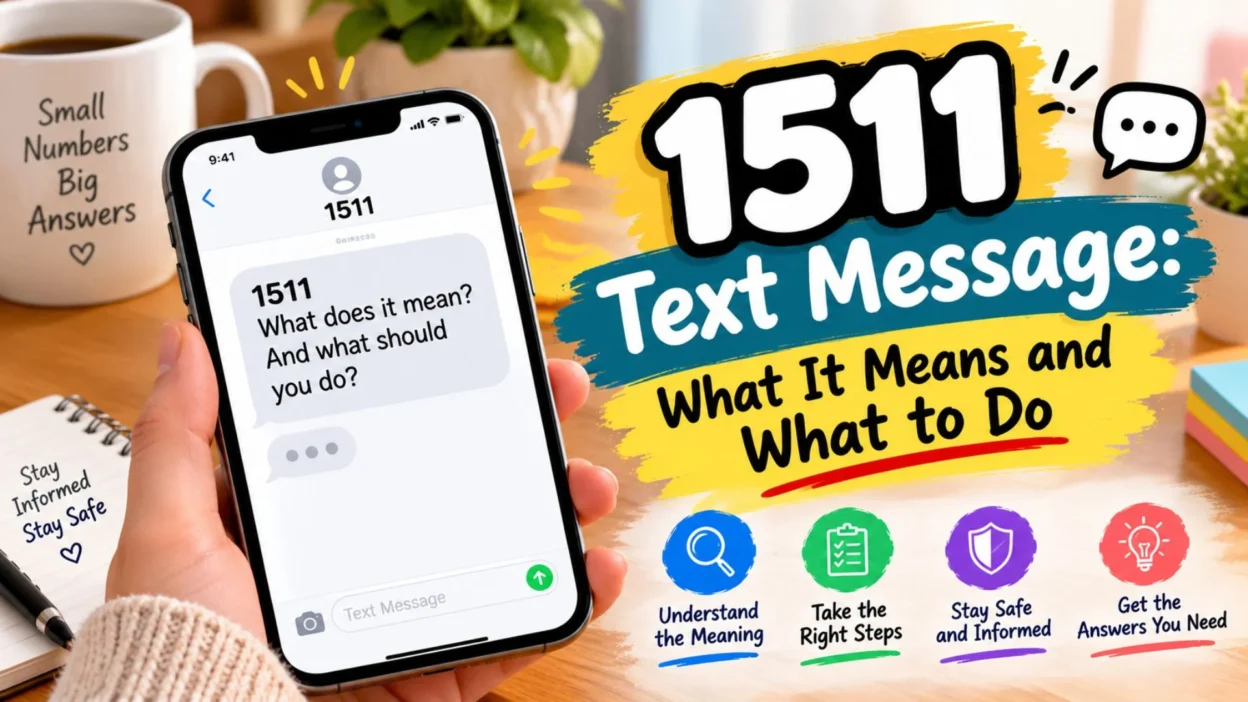
People searching for 1511 text message usually want to know why this short code appeared on their phone. They may have received an unexpected alert, account notification, or message and want to know whether it is genuine.
The important detail is that a short code does not automatically reveal the exact sender. T-Mobile officially lists 1511 among the short codes it uses, but short-code information can vary by country and messaging system.
Therefore, the safest approach is to examine the actual message. Look at its wording, links, requested actions, and whether you recently used a related service. If the message asks for sensitive information or pushes you to act urgently, pause before responding.
This guide explains what a 1511 text message may mean, how to check it safely, and what to do if the message looks suspicious.
What Is a 1511 Text Message?
A 1511 text message is an SMS that appears to come from the short code 1511 rather than a conventional phone number.
In the United States, T-Mobile’s official short-code support page lists 1511 among codes used by T-Mobile. The company explains that short codes can provide access to account details, plans, and services.
However, the number alone does not tell you exactly what a particular message means.
- A short code can be used for automated communications.
- The message may relate to an account or mobile service.
- Some alerts may be generated automatically.
- The meaning depends on the actual message content.
- Country and carrier can also affect how a short code is used.
- Therefore, avoid judging the message from the number alone.
- Check whether you recently changed an account setting.
- Consider whether you recently requested a service.
- Look for the name of the company inside the message.
- Check whether the message contains a verification code.
- Read the complete text before taking action.
- Be cautious with unexpected links.
- Never share passwords because a text asks for them.
- Never share sensitive account information without verification.
- When unsure, verify the sender through an official channel.
Why Did I Receive a Text From 1511?
There are several possible reasons for receiving a message from 1511. T-Mobile’s official documentation confirms that 1511 is one of the short codes associated with its messaging system.
Still, your specific message matters more than the short code itself.
- You may have triggered an account-related notification.
- A mobile service may have generated an automated alert.
- You may have recently changed an account setting.
- A service request could have generated the message.
- The message may relate to another account activity.
- Someone could have entered your number by mistake.
- You may have previously agreed to receive certain alerts.
- A message could arrive after a delayed account action.
- The text may contain information about a mobile service.
- You might recognize the activity once you read the full message.
- An unfamiliar message deserves extra attention.
- An unexpected link should not be opened immediately.
- Urgent language can be a warning sign.
- Requests for passwords should be treated with suspicion.
- When the message does not make sense, verify it independently.
Is a 1511 Text Message Legitimate?
A message from 1511 cannot be declared legitimate simply because it uses a recognizable short code.
T-Mobile confirms that 1511 is one of its listed short codes. However, the safest way to assess an individual message is to examine what it asks you to do.
- Check whether the message identifies the organization.
- Compare the information with your recent account activity.
- Look carefully at any web address.
- Avoid clicking unfamiliar links.
- Watch for unusual spelling or formatting.
- Be cautious when a message creates unnecessary urgency.
- Do not provide passwords through text messages.
- Do not share security codes with another person.
- Verify important information through the company’s official website.
- Use an official app when checking an account.
- Avoid calling numbers included in suspicious messages.
- Do not download unexpected attachments.
- Check whether you actually requested the service mentioned.
- Treat unexpected financial requests as a warning sign.
- When something feels inconsistent, stop and verify it first.
Who Sends Text Messages From 1511?
The sender associated with a short code depends on the messaging system and location.
For U.S. T-Mobile customers, the company’s official support page lists 1511 among the short codes it uses.
- T-Mobile lists 1511 among its other short codes.
- Short codes can support automated communications.
- The exact message can depend on the service involved.
- Different countries can have different short-code assignments.
- Third-party databases may show activity from 1511 in other countries.
- Therefore, country context matters.
- Your mobile carrier also matters.
- The wording inside the message provides additional clues.
- A company name may appear within the text.
- Some messages can be service-related.
- Others may involve account activity.
- An unfamiliar message should not be trusted automatically.
- Verify important information independently.
- Avoid assuming the sender from the number alone.
- Use your carrier’s official support channel when needed.
What Does a Message From 1511 Mean?
There is no single meaning that applies to every message from 1511.
For T-Mobile users in the U.S., 1511 is officially listed as one of T-Mobile’s short codes. The actual meaning depends on the communication you received.
- The message could concern a mobile account.
- It could provide a service notification.
- It may relate to account information.
- It could be an automated alert.
- The message may reference an action you recently took.
- It might explain a service-related event.
- The sender may identify itself in the message.
- The wording can reveal the purpose.
- A verification code can indicate an authentication event.
- A link can indicate that further action is requested.
- An unexpected request deserves careful checking.
- A familiar message may match recent activity.
- A suspicious message should not be acted on immediately.
- Checking your official account can provide useful context.
- When uncertain, contact the provider through a trusted channel.
Is 1511 a Real Text Message Number?
Yes, 1511 is a real short code used by T-Mobile in the United States, according to T-Mobile’s official support documentation.
That does not mean every message displayed as 1511 should automatically be trusted.
- T-Mobile officially lists 1511 among its short codes.
- Short codes are different from ordinary phone numbers.
- They are commonly used for automated messaging.
- The same digits can have different uses in different countries.
- Your carrier can help confirm the relevant sender.
- The message itself remains important.
- Check whether the content matches your activity.
- Be careful with unexpected links.
- Never disclose passwords because of a text.
- Do not share one-time security codes.
- Verify unexpected requests independently.
- Avoid responding to suspicious messages.
- Report unwanted messages when appropriate.
- Keep suspicious texts available if you need to report them.
- When uncertain, use official support instead of the message’s contact details.
Should You Reply to a 1511 Text?
Whether you should reply depends on the message and its source.
CTIA advises consumers to avoid responding to texts they do not recognize, especially when the message appears suspicious. It also recommends verifying uncertain messages through trusted channels.
- Read the message carefully first.
- Decide whether you recognize the service.
- Check whether you recently initiated the activity.
- Do not reply to an unfamiliar suspicious message.
- Do not click unexpected links.
- Do not provide personal information by text.
- Do not share passwords.
- Do not share verification codes.
- Avoid calling numbers included in suspicious texts.
- Use the company’s official website if verification is needed.
- Check your account through the official app.
- Keep a suspicious message for reporting.
- Use your phone’s junk-reporting feature when appropriate.
- Forward unwanted spam to 7726 in the U.S.
- Contact your carrier if the messages continue.
Is a 1511 Text Message a Scam?
A 1511 text message is not automatically a scam. T-Mobile officially lists 1511 as one of its short codes, so the number itself does not prove that a message is fraudulent.
At the same time, scammers can use convincing messages and impersonate trusted organizations. CTIA identifies unexpected messages, urgent demands, strange formatting, suspicious links, and requests for action as common warning signs.
- An unexpected message deserves closer attention.
- Urgent language can be a warning sign.
- Suspicious links should not be opened.
- Requests for passwords should raise concern.
- Requests for payment deserve independent verification.
- Strange grammar can indicate a suspicious message.
- A message may falsely claim to represent a trusted company.
- Do not rely on the sender ID alone.
- Verify the claim through an official website.
- Use an official app when possible.
- Do not call an unfamiliar number from the text.
- Never share security codes with someone who asks for them.
- Report suspicious texts to your carrier.
- Forward qualifying spam to 7726 in the U.S.
- Block the sender when appropriate.
How to Handle an Unexpected 1511 Text
An unexpected message does not always require immediate action. Instead, take a moment to understand what it says.
- Read the complete message.
- Check whether you recognize the service.
- Think about recent account activity.
- Do not click a suspicious link.
- Do not download an unexpected attachment.
- Avoid replying to an unfamiliar suspicious message.
- Do not provide personal information.
- Do not provide passwords.
- Do not share verification codes.
- Check the company’s official website separately.
- Open the official app if you have one.
- Compare the message with your account information.
- Save the message if you may need to report it.
- Use your phone’s reporting tools when appropriate.
- Contact your carrier if you still cannot identify it.
What to Do If You Keep Getting 1511 Messages
Repeated messages can become frustrating, especially when you do not recognize the reason for them.
Start by checking whether they relate to a service you use. If the messages appear suspicious, avoid interacting with links or requests inside them.
- Check whether the messages have similar wording.
- Look for repeated links or instructions.
- Confirm whether you recently changed an account setting.
- Review your account through an official channel.
- Do not respond to suspicious messages.
- Avoid clicking repeated unfamiliar links.
- Use your phone’s blocking feature when appropriate.
- Report unwanted texts through your carrier.
- Forward spam to 7726 in the U.S.
- Use your phone’s “Report Junk” option when available.
- Keep copies of suspicious messages for reference.
- Contact your carrier if the issue continues.
- Ask whether the messages relate to your account.
- Change account credentials only through the official service if compromise is suspected.
- Continue monitoring your account for unusual activity.
Can You Block Messages From 1511?
Yes, many phones provide options to block or report unwanted senders. The exact steps depend on your device and messaging app.
CTIA notes that consumers can use device-level blocking tools and report spam through 7726.
- Open the message in your messaging app.
- Look for the sender information.
- Check for a blocking option.
- Use “Report Junk” if your phone provides it.
- Avoid clicking links before reporting the message.
- Keep the original message if you may need evidence.
- Contact your carrier for additional help.
- Forward spam to 7726 in the U.S.
- Follow your carrier’s instructions for unwanted messages.
- Do not assume blocking will solve every account issue.
- If the message concerns a legitimate service, check your account first.
- Review notification preferences when available.
- Remove unwanted subscriptions through legitimate opt-out methods.
- Avoid replying to suspicious messages simply to make them stop.
- Continue monitoring your inbox after blocking.
How to Check a 1511 Text Message Safely
The safest approach is to verify the information without relying on links or phone numbers provided by an unexpected message.
- Start by reading the complete text.
- Identify the organization mentioned.
- Ask yourself whether you use that service.
- Check recent activity through the official app.
- Visit the official website manually.
- Do not use an unfamiliar link from the text.
- Look for unexpected payment requests.
- Watch for urgent deadlines.
- Check whether the message requests sensitive information.
- Never share a password through SMS.
- Never share a one-time security code.
- Avoid calling an unknown number from the message.
- Contact official support if the claim remains unclear.
- Report suspicious messages when appropriate.
- Delete the message after reporting it if you no longer need it.
Common Reasons for Receiving a 1511 SMS
A 1511 SMS can have different meanings depending on your carrier, country, and the content of the message. For U.S. T-Mobile customers, 1511 is officially listed among T-Mobile’s short codes.
- Account notifications
- Mobile service alerts
- Automated service messages
- Account-related information
- Notifications connected to recent activity
- Service changes
- Information about a mobile account
- Automated reminders
- Authentication-related communications
- Messages triggered by a customer request
- Messages caused by an incorrect phone number entry
- Unwanted promotional communication
- Messages you previously opted into
- Spam or suspicious messages
- Communications that require independent verification
How to Report a Suspicious 1511 Message
If a 1511 message looks suspicious, avoid interacting with it until you verify its source.
For U.S. mobile users, CTIA recommends forwarding unwanted or suspicious spam texts to 7726 (SPAM). Providers use reports sent through this system to improve spam filtering and blocking.
- Do not click suspicious links.
- Do not download unexpected attachments.
- Do not provide personal information.
- Do not share passwords.
- Do not share verification codes.
- Keep the original message if needed.
- Use your phone’s “Report Junk” feature when available.
- Forward spam to 7726 in the U.S.
- Follow your carrier’s reporting instructions.
- Contact the organization through its official website.
- Report serious fraudulent activity through appropriate government channels.
- Block the sender when necessary.
- Monitor your accounts after a suspicious message.
- Change credentials through official channels if you believe an account is at risk.
- Stay cautious with follow-up messages.
Copy-Paste Ready Safety Messages
These messages can help when you need a simple response to someone discussing an unexpected text.
- “I received a message from 1511 and I am checking the source before responding.”
- “I am going to verify this through the official website first.”
- “The message looks unexpected, so I will not click the link yet.”
- “I received an unfamiliar text and want to confirm whether it is legitimate.”
- “I am checking my account directly instead of using the link in the message.”
- “I will contact the company through its official support channel.”
- “The message seems unusual, so I am treating it cautiously.”
- “I am not sharing any account information until I verify the sender.”
- “I will report the message if it turns out to be spam.”
- “I am checking the details before taking any action.”
1511 Text Message FAQs
What is a 1511 text message?
A 1511 text message is an SMS displayed as coming from the short code 1511. In the U.S., T-Mobile officially lists 1511 among its short codes.
Is 1511 connected to T-Mobile?
T-Mobile’s official support page lists 1511 among the short codes it uses. However, short-code use can vary by country and context, so the actual message should still be checked.
Should I click a link in a 1511 text?
Do not click an unexpected or suspicious link. Instead, visit the relevant company’s official website or app separately and verify the information.
Can a 1511 message be a scam?
The short code alone does not prove that a message is a scam. However, suspicious links, urgent demands, unusual wording, and requests for sensitive information are warning signs.
How can I report a suspicious text?
In the United States, you can forward spam texts to 7726 (SPAM). CTIA also recommends using built-in reporting tools on supported phones.
Best 1511 Text Message Captions
These short lines can work when you want to describe an unexpected text without sharing private information.
- “Got an unexpected 1511 text today.”
- “Checking before clicking.”
- “Unknown message, so I am verifying first.”
- “Not every text deserves a quick reply.”
- “Read it, checked it, then acted.”
- “When a message looks unusual, pause first.”
- “Verification comes before clicking.”
- “A strange text is a reason to slow down.”
- “Checking the source before taking action.”
- “Smart texting starts with careful checking.”
Final Thoughts
Receiving an unexpected 1511 text message can naturally make you wonder what is happening. However, the short code alone does not provide the whole answer.
For U.S. T-Mobile customers, 1511 is officially listed as one of T-Mobile’s short codes. Yet the meaning of an individual message depends on its content, your account activity, and your location.
Therefore, take a calm approach. Read the message carefully, check whether you recognize the activity, and verify important information through an official app or website. Most importantly, avoid clicking unexpected links or sharing sensitive information simply because a text asks you to.
If a message appears suspicious, you have practical options. You can report spam through 7726 in the U.S., use your phone’s reporting tools, and block unwanted messages.
A few extra seconds of verification can prevent a rushed decision. When a text seems unusual, pause, verify, and then decide what to do.

Emma Richardson is a content writer passionate about creating heartfelt messages, wishes, and greetings for every occasion. She enjoys helping readers express their emotions with meaningful words that strengthen relationships and celebrate life’s special moments.