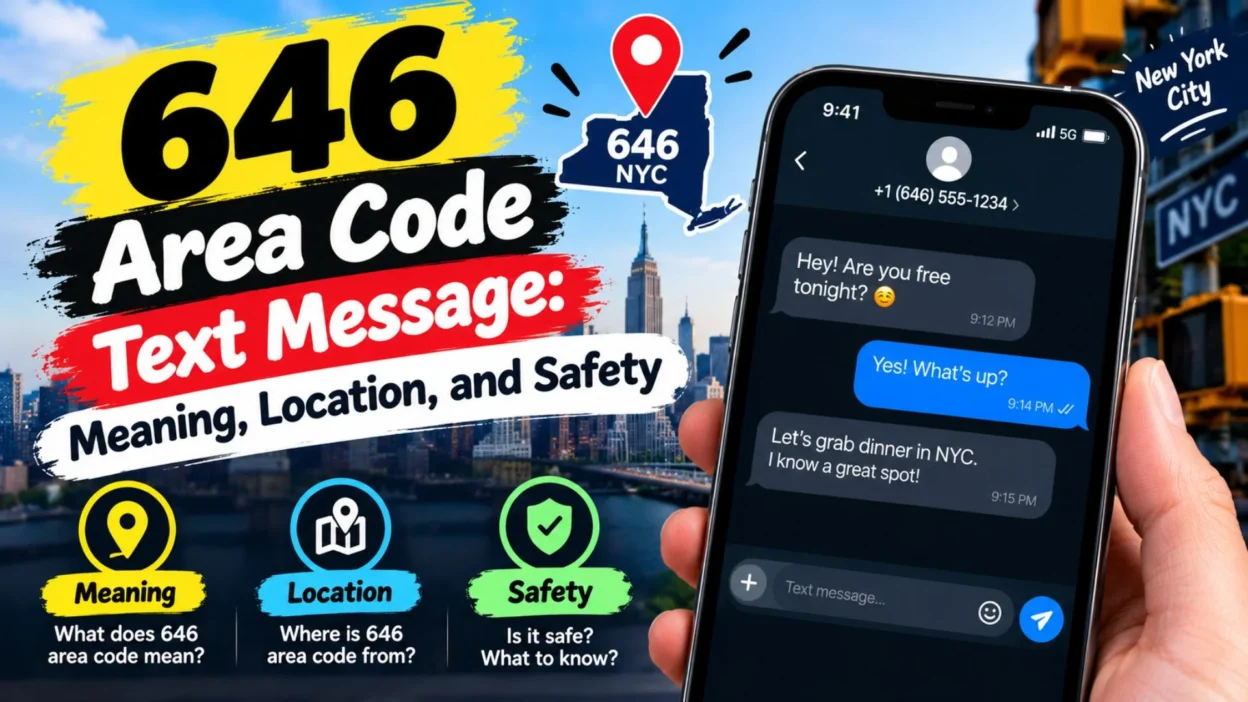
Receiving a text from an unfamiliar number can leave you wondering who is contacting you. When the number starts with 646, you may want to know where it comes from and whether you should reply.
A 646 area code text message is associated with New York City, particularly Manhattan. You might receive one from a local business, a service provider, a new contact, or someone who has the wrong number. However, the area code alone cannot confirm the sender’s identity or current location.
Sometimes, an unexpected message is harmless. In other cases, it may be an unwanted advertisement, a phishing attempt, or a scam designed to get your personal information. Therefore, it is important to look at the message itself rather than trusting the phone number.
This guide covers the meaning of the 646 area code, common reasons people receive these messages, and simple ways to check whether a text seems trustworthy. You will also find practical examples, safe response options, and answers to frequently asked questions.
🗽 What Does the 646 Area Code Mean?
The 646 area code serves Manhattan in New York City, New York. It is part of the city’s telephone numbering system and is associated with the same general geographic region as several other New York City area codes.
If you receive a text from a number beginning with 646, the number is associated with the Manhattan area. However, this does not prove that the sender currently lives or works there.
People can keep phone numbers when they move. Businesses may also use phone services that allow messages to be sent from numbers that do not reflect their physical location.
- 📍 Geographic association: Manhattan, New York City.
- 📲 Possible senders: Individuals, businesses, organizations, and automated messaging services.
- 🌐 Online communication: Some services use phone numbers for verification, alerts, and customer support.
- ⚠️ Important reminder: A familiar area code does not automatically make a message trustworthy.
The safest approach is to consider the sender, message content, and any links or requests included in the text.
💬 Why Did I Receive a 646 Area Code Text Message?
There are several possible reasons for receiving a message from a 646 number. The explanation depends on the sender and what the text says.
- 👋 Someone you know: A friend, relative, colleague, or acquaintance may be using a New York number.
- 🏢 A business notification: A company may send an appointment reminder, delivery update, or customer service message.
- 🔐 A verification code: An online service may send a one-time code when you request account verification.
- 📦 A delivery update: A courier or retailer may contact you about an order.
- 📞 A wrong number: The sender may have entered an incorrect phone number by mistake.
- 📢 Marketing messages: A business may send promotional texts if you signed up for its updates.
- 🎭 An unexpected contact: A stranger may send a greeting or claim to know you.
- 🚩 A possible scam: A message may try to collect sensitive information or encourage you to open a suspicious link.
An unfamiliar number does not necessarily indicate a problem. Still, be careful if the sender creates urgency, asks for money, or requests private account details.
If the text claims to come from a company you use, verify the claim through its official app or website rather than relying on the message.
🏙️ Where Is the 646 Area Code Located?
The 646 area code is associated with Manhattan, one of New York City’s five boroughs. Manhattan includes many residential neighborhoods, commercial districts, offices, shops, and tourist destinations.
You may recognize places such as Midtown Manhattan, the Upper West Side, Harlem, and Lower Manhattan as parts of this borough.
The area code is used alongside other New York City telephone area codes. Because numbers can be retained or used through internet-based phone services, the prefix does not tell you exactly where a person is at the time of texting.
- 🏢 A business may use a 646 number for customer communication.
- 🏠 A person may retain a 646 number after moving elsewhere.
- 📱 A mobile number may be used while its owner travels.
- 🌐 An internet-based service may send messages using a number associated with Manhattan.
Therefore, a 646 number is a geographic clue, not a reliable way to identify a person’s present location.
🛡️ Is a 646 Area Code Text Message Legitimate?
A text from a 646 number can be legitimate, but the area code itself cannot establish whether a message is genuine.
Scammers can use various phone numbers to contact people. In some cases, caller ID or sender information may be spoofed, making a message appear to come from a different number.
Before responding, consider these warning signs:
- 🚩 Unexpected payment requests: The sender demands money for a fee, prize, or urgent problem.
- 🔗 Suspicious links: The message asks you to open an unfamiliar website.
- 🔐 Requests for verification codes: Someone asks you to share a login or one-time security code.
- ⏰ Artificial urgency: The sender threatens to close an account unless you act immediately.
- 🎁 Unrealistic rewards: The message promises a prize you never entered to win.
- 👤 Unclear identity: The sender claims to know you but cannot explain how.
- 💳 Sensitive information requests: The person asks for passwords, banking details, or other private information.
One warning sign does not always prove fraud. However, several warning signs together deserve extra caution.
If a message claims that your bank, delivery company, or online account needs attention, check directly through the official service. Avoid using contact details supplied in a suspicious message.
📩 How to Respond to an Unknown 646 Number
You do not have to respond to every unfamiliar text. The best action depends on whether the message looks legitimate and whether you recognize the sender.
- ✅ For a clear, legitimate message: Follow up through the company’s official contact channel if necessary.
- 🤔 For a possible wrong number: You can ignore it if you do not feel comfortable responding.
- 🛑 For a suspicious link: Do not open it or enter personal information.
- 🔐 For an unexpected security code: Do not share it with anyone. Check your account if you did not request the code.
- 🚫 For repeated unwanted messages: Block the number and report the message through your phone or messaging service.
- 💬 For a message from someone you may know: Ask a neutral question without revealing personal details.
If you choose to reply to a genuine but unfamiliar contact, keep your response brief. You do not need to provide your full name, home address, workplace, school, or other identifying information.
When a message seems suspicious, ignoring it is often safer than engaging with the sender.
🔗 What Should You Do If a 646 Text Contains a Link?
Unexpected links can lead to fake websites designed to collect passwords, payment information, or personal details. Some may also direct you to pages that imitate familiar companies.
Even if the text appears professional, do not assume the link is safe.
Use these precautions:
- 🔍 Check the context: Ask yourself whether you expected the message.
- 🌐 Visit the official website: Type the known website address yourself or open the official app.
- 🔒 Protect your login details: Never enter passwords after following a suspicious message.
- 💳 Avoid unexpected payments: Verify any fee through a trusted source first.
- 📱 Keep your device updated: Install operating system and security updates when available.
- 🚫 Do not download unknown files: Unexpected attachments may contain harmful software.
If you already opened a suspicious link, do not panic. Simply opening a link does not always mean your device or accounts have been compromised. Close the page and avoid entering information or downloading anything.
If you entered a password, change it through the official website or app. If you supplied payment information, contact your financial institution using a trusted phone number.
🔐 What If You Receive an Unexpected Verification Code?
A text from a 646 number may contain a one-time password or account verification code. These codes help services confirm access to an account or verify a login attempt.
If you requested the code yourself, use it only on the official service where you started the process.
If you did not request it, someone may have entered your number by mistake. Alternatively, someone may be trying to access an account associated with your phone number.
Take these steps:
- 🔑 Never share the code with another person.
- 📲 Do not reply with the code, even if the sender claims to be customer support.
- 🔍 Check your account through the official app or website.
- 🔒 Review recent account activity if the service offers that option.
- 🛡️ Update your password if you notice suspicious activity.
- 📞 Contact the service through its verified support channel if you need help.
A genuine verification code should be treated as private. Anyone asking you to forward it may be trying to gain access to an account.
🚫 How to Block or Report Suspicious 646 Text Messages
If a number keeps sending unwanted or suspicious messages, you can usually block it through your phone’s messaging app. Many messaging services also provide ways to report spam.
The exact steps vary by device and app, but the general process is straightforward.
- 📱 Open the conversation: Find the message you want to report.
- ⚙️ Check the available options: Look for a menu containing sender details, blocking, or reporting controls.
- 🚫 Block the sender: Use this option if you do not want further messages from that number.
- 🚩 Report spam: If the option is available, submit the message for review.
- 🗑️ Delete the conversation: Remove it after taking any steps needed to report or document the issue.
- 🔐 Secure your accounts: If you shared information, take appropriate steps to protect it.
In the United States, unwanted or fraudulent texts can also be reported to the appropriate authorities. The Federal Trade Commission provides guidance for reporting scams at its official website, ReportFraud.ftc.gov.
Do not reply to suspicious messages simply to tell the sender to stop. In some cases, responding can confirm that your number is active.
❓ Frequently Asked Questions
What city uses the 646 area code?
The 646 area code is associated with Manhattan in New York City, New York. However, a number with this prefix does not prove the sender is currently in Manhattan.
Is a 646 area code text message a scam?
Not necessarily. It may come from a legitimate person, business, or service. Check the message for suspicious links, unusual payment requests, and demands for private information.
Why is a 646 number texting me?
The sender could be someone you know, a business, an automated service, a wrong number, or an unwanted contact. The content of the message can help you determine the next step.
Should I reply to an unknown 646 number?
You do not have to reply. If the message seems suspicious, ignore it, block the sender, or report it. If it claims to come from a business, verify the claim independently.
Can I identify someone from a 646 phone number?
The area code can indicate a geographic association with Manhattan, but it cannot reliably identify the owner or their current location. Avoid trusting a message based only on its phone number.
✅ Conclusion
Receiving a 646 area code text message can be completely ordinary, especially when it comes from a business, acquaintance, or legitimate service. The number is associated with Manhattan, New York City, but it does not prove who sent the message or where they are now. If you do not recognize the sender, take a moment to review the message before replying. Avoid suspicious links, unexpected payment requests, and anyone asking for passwords or verification codes. When a text claims to represent a company, contact that company through its official website or app. You can also block and report unwanted messages if they continue. Staying calm, protecting your personal information, and verifying unexpected requests will help you handle unfamiliar texts with greater confidence.

Emma Richardson is a content writer passionate about creating heartfelt messages, wishes, and greetings for every occasion. She enjoys helping readers express their emotions with meaningful words that strengthen relationships and celebrate life’s special moments.