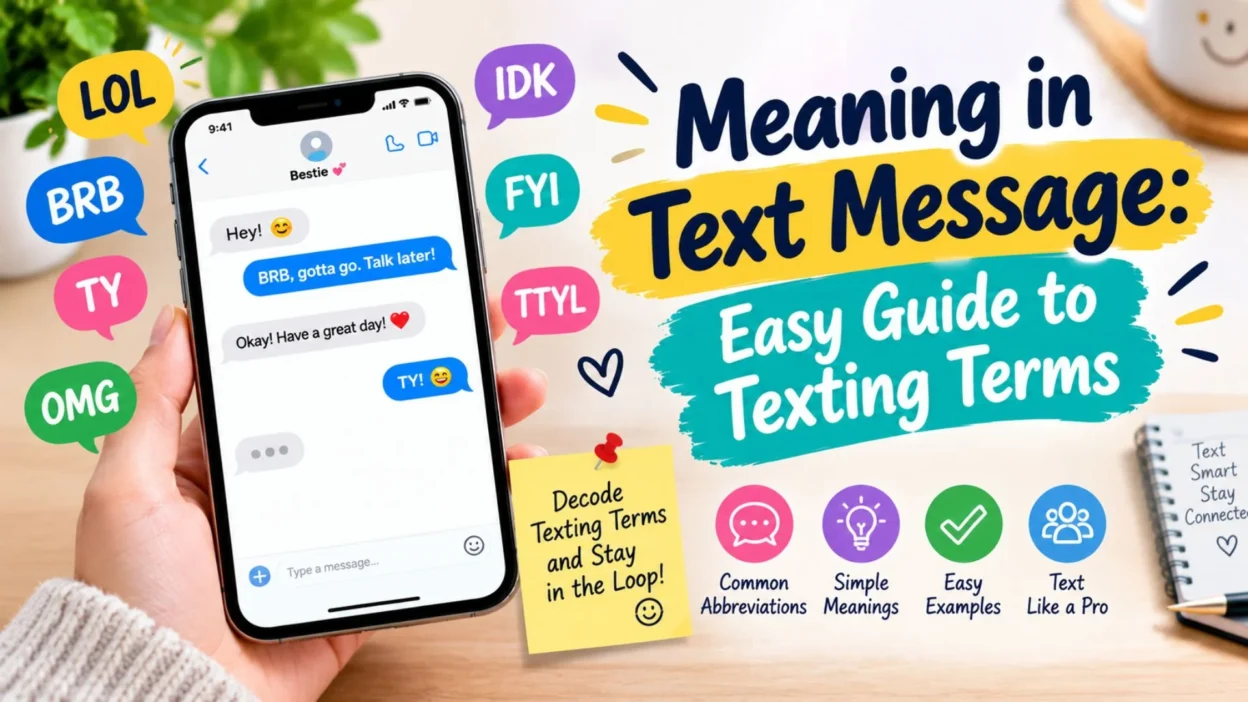
Have you ever received a text and wondered what a certain word, abbreviation, emoji, or symbol means? You are not alone. Modern texting has created its own language, and new expressions appear all the time. That is why people often search for the meaning in text message when they see something unfamiliar.
Text messages can be surprisingly easy to misunderstand. A short abbreviation may have several meanings depending on the conversation. An emoji can also communicate a feeling that words do not clearly express. Even punctuation, capitalization, or a simple “K” can sometimes change the tone of a message.
Understanding texting language helps you communicate with more confidence. It can also prevent unnecessary confusion when you are chatting with friends, family, classmates, or coworkers.
This guide explains what meaning in text message usually refers to, how texting abbreviations work, what common symbols mean, and how context changes the meaning of a message. You will also find practical examples that make unfamiliar texting terms easier to understand.
What Does Meaning in Text Message Mean?
The search phrase meaning in text message usually has an informational intent. Someone may have received a message containing an abbreviation, symbol, emoji, or unusual expression and wants to understand it.
For example, a person might search for the meaning of terms such as “LOL,” “BRB,” “IDK,” “BTW,” or “HMU.” They may also want to understand what a particular emoji or punctuation mark means in a conversation.
The important thing to remember is that texting language depends heavily on context. The same abbreviation can mean different things in different situations.
What Does Meaning in Text Message Refer To?
The phrase “meaning in text message” can refer to the interpretation of almost anything used in a digital conversation.
It may include:
- An abbreviation such as “BTW”
- A slang word such as “sus”
- An emoji such as 😂
- A symbol such as ❤️
- An acronym such as “IMO”
- A punctuation choice such as “…”
- A reaction such as a thumbs-up
- A short response such as “k”
- A phrase such as “my bad”
- Internet slang used in casual conversations
In simple terms, someone searching for the meaning in text message wants to know what a particular piece of texting language means and how it should be understood.
Why Text Message Meanings Can Be Confusing
Texting is different from face-to-face conversation because you cannot hear the other person’s voice or see their facial expression.
When someone speaks, their tone can help explain whether they are joking, annoyed, excited, or serious. Text messages remove much of that information.
For example, consider these responses:
- “Okay!”
- “Okay.”
- “okay”
- “K”
The basic word is similar, but the tone may feel different depending on the relationship and conversation.
That does not mean every short response has a hidden meaning. Sometimes “okay” simply means okay. Context matters more than assumptions.
Context Changes Meaning
The same abbreviation can have different interpretations depending on the situation.
For example, “PM” could refer to a private message in a social media conversation. In another context, it can refer to a time of day.
Likewise, “ID” might mean identification, while “IDK” usually means “I don’t know” in casual texting.
Therefore, never rely on the abbreviation alone. Look at the surrounding words and consider what the conversation is about.
Relationship Also Matters
Texting between close friends may look very different from texting between coworkers.
Friends often use slang, abbreviations, memes, emojis, and playful expressions. Professional conversations usually require clearer and more direct language.
A message that feels completely normal between friends may seem too casual in a workplace conversation.
Common Text Message Abbreviations and Their Meanings
Texting abbreviations save time and space. Many became popular through early mobile phones, online chats, and social media.
Here are some of the most common ones.
LOL
LOL usually means “laughing out loud.”
People use it to show that something is funny or to make a message feel lighter.
Example:
- “That video was hilarious LOL.”
However, LOL does not always mean someone is literally laughing out loud. It can simply signal amusement or a playful tone.
OMG
OMG means “oh my gosh” or “oh my God.”
People commonly use it to express surprise, excitement, disbelief, or shock.
Example:
- “OMG, I can’t believe you remembered!”
The exact interpretation depends on the conversation.
BTW
BTW means “by the way.”
It introduces an additional thought or piece of information.
Example:
- “BTW, are you coming tomorrow?”
It is common in casual texting and online conversations.
IDK
IDK means “I don’t know.”
It is one of the most common casual texting abbreviations.
Example:
- “IDK what time they are arriving.”
The abbreviation usually indicates uncertainty rather than a negative attitude.
BRB
BRB means “be right back.”
Someone may use it when they temporarily need to leave a conversation.
Example:
- “BRB, someone is calling me.”
It generally means the person expects to return soon.
TTYL
TTYL means “talk to you later.”
People often use it when ending a conversation temporarily.
Example:
- “I have to go now. TTYL!”
FYI
FYI means “for your information.”
It introduces information that the sender believes may be useful to the recipient.
Example:
- “FYI, the meeting starts at 10.”
Depending on the tone, FYI can sound neutral, helpful, or slightly formal.
IMO
IMO means “in my opinion.”
It tells the reader that the statement represents the sender’s personal view.
Example:
- “IMO, the first option is better.”
TBH
TBH means “to be honest.”
People often use it before expressing a sincere opinion or feeling.
Example:
- “TBH, I really enjoyed the movie.”
ASAP
ASAP means “as soon as possible.”
It is used when something should be done quickly.
Example:
- “Please send the document ASAP.”
Although common in professional communication, it can also appear in casual texts.
LMK
LMK means “let me know.”
Example:
- “LMK if you need anything.”
It is a convenient way to ask someone to provide an update or response later.
NVM
NVM usually means “never mind.”
Someone may use it when they no longer need an answer or have changed their mind.
Example:
- “NVM, I found it.”
JK
JK means “just kidding.”
It tells the reader that a previous statement was intended as a joke.
Example:
- “You owe me a million dollars. JK!”
Context is important because jokes can sometimes be misunderstood over text.
Common Texting Slang and Their Meanings
Abbreviations are not the only form of texting language. Slang also plays a major role in digital communication.
“Sus”
“Sus” is short for “suspicious” or “suspect.”
It became especially popular through online gaming and social media.
Example:
- “That explanation sounds sus.”
It is usually casual and sometimes playful.
“Bet”
In casual texting, “bet” can mean “okay,” “sounds good,” or “I agree.”
Example:
- “Meet me at 6?”
- “Bet.”
The meaning depends on the conversation.
“Cap” and “No Cap”
In internet slang, “cap” can refer to a lie or exaggeration.
“No cap” generally means “I’m being honest” or “I’m not lying.”
Example:
- “No cap, that was the best pizza I’ve had.”
These expressions are informal and may not be suitable for every audience.
“Ghosting”
Ghosting refers to suddenly stopping communication with someone without explanation.
Example:
- “We were talking every day, then they started ghosting me.”
It is commonly used when discussing friendships, dating, or social relationships.
“Vibe”
“Vibe” refers to the overall feeling, mood, or atmosphere of something.
Example:
- “This place has a great vibe.”
It can also describe someone’s personality or energy.
“Mood”
“Mood” can mean that someone strongly relates to a statement or situation.
Example:
- “I just want to sleep all weekend.”
- “Mood.”
It usually expresses agreement or identification with the feeling.
Common Emojis and Their Meanings in Text Messages
Emojis can add emotion and personality to text messages. However, their meaning can change depending on context.
❤️ Red Heart
The red heart commonly expresses love, affection, appreciation, or strong emotional warmth.
It can be romantic, but it can also be used between family members and friends.
😂 Face With Tears of Joy
This emoji commonly expresses strong laughter or amusement.
Example:
- “That was the funniest thing I’ve seen today 😂”
😊 Smiling Face
The smiling face can communicate happiness, friendliness, gratitude, or warmth.
The exact tone depends on the surrounding conversation.
😭 Loudly Crying Face
This emoji is often used for sadness, but online conversations also use it to express overwhelming laughter, excitement, or strong emotion.
For example, someone might write:
- “That was so funny 😭”
In that context, the person may be laughing rather than literally crying.
😭 Can Have Multiple Meanings
This is an excellent example of why context matters when understanding the meaning in text message.
An emoji does not always have one fixed interpretation. Online culture can give familiar symbols additional meanings.
👍 Thumbs Up
The thumbs-up emoji often means “okay,” “got it,” “sounds good,” or approval.
However, some people may interpret a short thumbs-up response as distant or abrupt.
That difference usually comes from personal communication style rather than a universal rule.
🙏 Folded Hands
This emoji can express prayer, gratitude, appreciation, hope, or a request.
Its meaning depends on the surrounding text.
😂 vs. 🤣
Both commonly express laughter.
The rolling-on-the-floor-laughing emoji often suggests especially strong amusement, while the face-with-tears-of-joy emoji is commonly used for something very funny.
What Do Text Message Symbols Mean?
Text messages can contain symbols that communicate more than words.
Common examples include:
- ❤️ for love or affection
- 💯 for strong agreement or emphasis
- ✨ for excitement, positivity, or emphasis
- 🔥 for something impressive or excellent
- 💀 for extreme amusement in some online contexts
- 👀 for interest, attention, or “I’m watching”
- 🎉 for celebration
- ✅ for completion or approval
The intended meaning depends on the sender and conversation.
For example, “That outfit is 🔥” usually means the sender thinks the outfit looks excellent. It is not normally referring to literal fire.
What Does “…” Mean in a Text Message?
The three-dot ellipsis can have several meanings.
Someone may use it to show that a thought is unfinished. They may also use it to create a pause.
For example:
- “I thought you were coming…”
Depending on the context, this could sound disappointed, surprised, or simply unfinished.
However, punctuation preferences vary from person to person. You should not automatically assume that an ellipsis means someone is upset.
What Does “K” Mean in a Text Message?
“K” is a short form of “okay.”
However, its tone can depend heavily on the conversation.
Compare:
- “Okay!”
- “Okay.”
- “K”
Some people use “K” casually without intending anything negative. Others may use it when they are annoyed or want to end a conversation.
The relationship between the people also matters.
If you are unsure, look at the messages before and after it rather than interpreting one letter by itself.
What Does “OK” Mean in Texting?
“OK” generally means agreement, acknowledgment, or understanding.
It can communicate:
- Agreement
- Confirmation
- Understanding
- Acceptance
- Acknowledgment
For example:
- “I’ll send it tonight.”
- “OK.”
This usually means the person received and understood the information.
Again, tone can change depending on punctuation and the broader conversation.
How Capitalization Changes Texting Tone
Capitalization can sometimes affect how a message feels.
For example:
- “Sure.”
- “SURE!”
- “sure”
These messages technically communicate similar information. However, the visual presentation may create different impressions.
Writing everything in capital letters can sometimes feel like shouting, especially in emotional conversations.
On the other hand, some people use uppercase letters simply for emphasis or excitement.
Therefore, capitalization should be interpreted alongside context.
How Punctuation Changes the Meaning of a Text
Punctuation can make a surprisingly large difference in digital communication.
Compare:
- “Really?”
- “Really!”
- “Really.”
Each can communicate a different feeling.
A question mark usually indicates uncertainty or a question. An exclamation mark often adds excitement or emphasis. A period can make a short response feel more formal or final.
Still, punctuation habits differ. One person’s “Okay.” may feel perfectly normal, while another person’s “Okay.” may feel unusually serious.
Why Context Matters More Than the Abbreviation
One of the biggest mistakes people make when searching for the meaning in text message is assuming that every abbreviation has only one meaning.
That is not always true.
Consider “PM.” It might mean:
- Private message
- Afternoon or evening time
- Project manager
- Other terms depending on the subject
The surrounding conversation usually tells you which meaning applies.
For this reason, do not interpret an unfamiliar term in isolation. Read the entire message and consider what you were discussing.
How to Understand an Unfamiliar Texting Term
If someone sends you a term you do not recognize, there are several simple ways to understand it.
Read the Whole Conversation
Look at the messages immediately before and after the unfamiliar term.
Often, the context makes the meaning obvious.
Consider Who Sent It
A close friend may use slang that a coworker would never use. A family member may have their own texting habits.
The sender’s usual communication style can provide useful clues.
Look at the Tone
Ask yourself whether the conversation is serious, funny, casual, emotional, or professional.
The same word can feel different in each situation.
Ask Politely
If you still do not understand the term, simply ask.
A quick response such as “What does that mean?” is completely reasonable.
There is no need to pretend you understand unfamiliar slang.
Texting Terms Used in Friendly Conversations
Friends often use informal language because they are comfortable with one another.
Common examples include:
- LOL
- OMG
- IDK
- BTW
- BRB
- TTYL
- LMK
- TBH
- JK
- NVM
- Haha
- Yep
- Yep!
- Cool
These expressions can make conversations faster and more relaxed.
Texting Terms Used in Professional Conversations
Professional texting usually requires more care.
Some abbreviations are acceptable in casual workplace communication, while others may feel too informal.
For example, these can often be understood easily:
- FYI
- ASAP
- ETA
- EOD
- OOO
However, professional communication should prioritize clarity.
If a message could be misunderstood, spelling out the phrase may be better than using an abbreviation.
For example, instead of assuming someone understands an unfamiliar acronym, write the complete phrase.
Common Texting Mistakes to Avoid
Understanding texting language is useful, but so is knowing when not to use it.
Using Too Much Slang
A message filled with slang can become difficult to understand.
This is especially true when communicating with someone who does not regularly use internet expressions.
Assuming Every Short Reply Is Negative
A short response does not automatically mean someone is angry or upset.
Some people naturally text with fewer words.
Misreading Emojis
An emoji may have several interpretations. Avoid jumping to conclusions without considering the full message.
Using Casual Abbreviations in Formal Situations
Terms like “LOL,” “JK,” or “NVM” may not fit every professional or formal conversation.
When in doubt, choose clear language.
Text Message Meaning vs. Real-Life Meaning
Digital communication often creates meanings that differ slightly from everyday speech.
For example, “LOL” literally refers to laughing out loud, but many people use it simply to signal amusement.
Similarly, “OMG” can express surprise without indicating strong religious or emotional meaning.
An emoji may also replace an entire sentence.
This is one reason texting continues to evolve. People develop shared digital habits, and those habits influence how words and symbols are understood.
How Texting Language Changes Over Time
Texting language is not fixed.
New abbreviations, slang terms, memes, and emoji meanings can become popular quickly. Some expressions remain common for years, while others disappear after a short period.
Social media, online gaming, messaging apps, and popular internet culture all influence these changes.
That means an expression that was common several years ago may sound outdated today.
Likewise, a new slang term may be familiar to younger users but unfamiliar to older generations.
This constant change is another reason context is so important.
Is Texting Slang the Same Everywhere?
No. Texting language can vary by country, age group, community, and platform.
An expression that is common in the United States may not be equally common elsewhere.
Even within the same country, different groups may use different slang.
Some expressions are also strongly connected to particular online communities.
Therefore, when you search for the meaning in text message, consider where the message came from and who sent it.
How to Respond When You Understand the Meaning
Once you understand an unfamiliar term, you can respond naturally.
For example:
- “Got it!”
- “Ah, that makes sense.”
- “Thanks for explaining.”
- “I hadn’t heard that one before.”
- “Okay, now I understand.”
There is nothing embarrassing about asking for clarification. Texting language changes constantly, and nobody knows every abbreviation or slang expression.
Frequently Asked Questions
What does “meaning in text message” mean?
“Meaning in text message” generally refers to understanding what a word, abbreviation, emoji, symbol, phrase, or punctuation choice means within a text conversation.
How can I find the meaning of an abbreviation in a text?
Start by looking at the surrounding conversation. Consider the topic, the sender, and the tone. If the meaning is still unclear, ask the sender or look up the specific abbreviation.
Can one text abbreviation have multiple meanings?
Yes. Many abbreviations have more than one possible meaning. The correct interpretation usually depends on the subject and context of the conversation.
Do emojis have fixed meanings?
Not always. Emojis have common meanings, but people can use them differently. Internet culture can also give an emoji additional meanings.
Why does the same text sometimes feel different?
Tone can change because of punctuation, capitalization, word choice, emojis, and the relationship between the people communicating. Context is important when interpreting short messages.
Final Thoughts
Understanding the meaning in text message can make digital conversations much easier. From common abbreviations such as LOL and IDK to emojis, slang, punctuation, and short replies, texting has developed a language of its own.
Still, there is no universal rule for every message. Context, relationship, tone, and personal texting habits all influence what someone means.
If you receive an unfamiliar term, do not immediately assume the worst. Read the full conversation first. Consider what you were discussing and how the sender normally communicates. In many cases, the intended meaning becomes clear.
When it does not, simply ask. A quick question is often better than making an incorrect assumption.
As texting continues to evolve, new expressions will keep appearing. You do not need to know every piece of internet slang to communicate well. You simply need to stay curious, pay attention to context, and choose clear words when meaning matters.
Good communication is not about knowing every texting abbreviation. It is about making sure the other person understands what you mean.

Emma Richardson is a content writer passionate about creating heartfelt messages, wishes, and greetings for every occasion. She enjoys helping readers express their emotions with meaningful words that strengthen relationships and celebrate life’s special moments.